De-Risking Infusion Therapy: A Profitable Guide to Starting an Infusion Clinic with 340B Support
How FQHCs and safety-net providers can evaluate infusion clinic economics, reduce startup risk, and use 340B support to launch an in-house infusion program with more confidence.

Remy Healthcare Team
7 min read · November 18, 2024 · Updated May 17, 2026
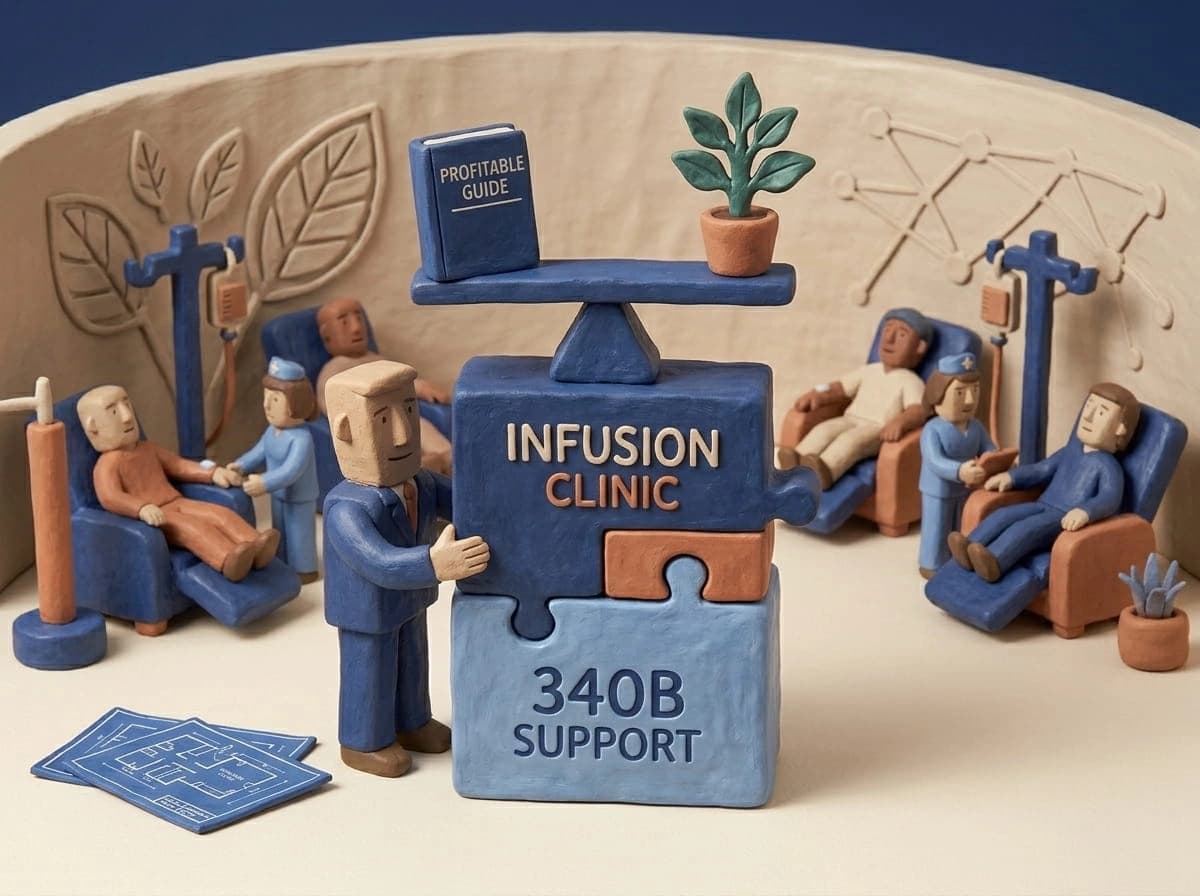
Starting an infusion clinic can feel expensive, complex, and risky. For many FQHCs and safety-net providers, the opportunity is obvious but the path is not. High-cost medications, staffing concerns, compliance risk, and uncertain ROI can make infusion services feel out of reach.
The reality is more nuanced. With the right patient mix, operating model, and 340B support, an infusion program can become one of the most strategic ways to expand access to care while building a new revenue stream.
Key Takeaways
- Infusion clinics do not always require large buildouts. Many programs can start in a modest, compliant footprint.
- 340B can materially reduce the financial risk of carrying high-cost infused medications.
- The biggest risks are usually not space alone. They are workflow, staffing, reimbursement, and compliance design.
- The strongest launch model is one that treats infusion as both a care-delivery strategy and an operating system.
Why infusion demand keeps growing
More patients now rely on infused therapies for autoimmune disease, oncology, complex infections, and other chronic conditions. In many markets, those patients still travel off-site for care, creating access friction and sending both clinical continuity and margin elsewhere.
For eligible providers, bringing infusion in-house can solve several problems at once:
- more convenient treatment access
- better continuity with primary and specialty care
- improved retention of high-value service lines
- tighter visibility into drug and reimbursement performance
The real question is not "Can we do it?"
The better question is: "Can we launch it in a way that controls risk from the start?"
An infusion clinic becomes risky when the organization underestimates four things:
- medication acquisition economics
- staffing and scheduling design
- reimbursement workflow
- compliance and audit readiness
That is why de-risking matters more than simply "opening a clinic."
340B changes the startup equation
For covered entities, medication acquisition is often the single biggest barrier to entry. 340B support can change that quickly.
When infused therapies are purchased under a compliant 340B model, the cost basis can become materially more manageable. That improves not only margin potential but also launch confidence. Instead of carrying full commercial acquisition cost on day one, the provider can evaluate infusion growth under a much more favorable structure.
340B does not remove operational complexity. It does, however, reduce one of the most significant financial barriers: the cost of high-value drug inventory.
Space is usually less of a blocker than people think
Many leaders assume an infusion program requires a large new facility. Often it does not.
In the early stage, a right-sized infusion suite can be created from an existing exam room or underused clinical area if the site supports:
- patient comfort and observation
- sink access and workflow efficiency
- compliant medication handling
- emergency readiness
- clean scheduling flow
The key is not maximum square footage. It is whether the space supports safe, repeatable treatment delivery.
What an infusion launch actually needs
Before launch, most organizations should confirm five foundations:
1. Clinical and patient-fit analysis
You need to know which patients and therapies make the most sense to bring on-site first. A broad ambition is not enough. The first wave should be selected based on demand, clinical feasibility, reimbursement profile, and staffing readiness.
2. Reimbursement and payer planning
Even strong clinical demand can underperform financially if authorization, billing, or payer contract strategy is weak. The operating model should be designed around realistic reimbursement mechanics, not just projected volume.
3. Staffing and workflow design
Infusion services depend on dependable staffing, handoffs, and treatment-day flow. This includes nursing, scheduling, pharmacy support, documentation, and escalation pathways.
4. Compliance framework
For 340B-covered programs, patient eligibility, documentation, inventory integrity, and audit readiness need to be built into the launch model from the beginning.
5. Revenue model and launch pacing
A good pro forma should reflect therapy mix, drug economics, staffing assumptions, reimbursement timing, and ramp expectations. Overly optimistic forecasts are one of the easiest ways to turn a promising program into a stressful one.
Where organizations usually take on avoidable risk
We see the same launch mistakes repeatedly:
- building space before validating therapy mix
- focusing on drug savings without mapping reimbursement
- launching without clear 340B compliance ownership
- underestimating staffing and scheduling complexity
- assuming consultants or vendors will solve every operational gap automatically
The solution is not overbuilding. It is sequencing the work correctly.
How to de-risk the financial model
If your goal is a sustainable infusion program, the financial model should answer more than "Will this make money?"
It should answer:
- Which therapies create the strongest contribution margin?
- Which payer classes create the most friction?
- How long does authorization delay cash realization?
- What staffing level supports safe capacity?
- What is the ramp path from one room to a broader program?
The strongest models begin with a narrow, high-confidence launch rather than a large speculative footprint.
Why the right partner model matters
Many providers do not want to build infusion infrastructure entirely on their own, and that is reasonable. The right partner can help with:
- facility planning
- staffing design
- vendor coordination
- procurement workflow
- 340B and TPA support
- reimbursement operations
- launch analytics
The important distinction is that a partner should reduce complexity, not hide it. You still need a clear operating model and transparent economics.
Infusion growth is not just about margin
A well-run infusion clinic can improve patient care in ways that do not appear in a spreadsheet right away:
- fewer treatment delays
- less travel burden
- stronger adherence
- better continuity between prescribers and treatment delivery
- greater trust in the local care model
Those care advantages are often what make the financial model more durable over time.
A practical launch sequence for FQHCs
If you are evaluating an in-house infusion program, a smart first sequence looks like this:
- Confirm the patient and therapy opportunity.
- Model drug economics and payer reality, not just revenue upside.
- Validate a right-sized space and staffing model.
- Build 340B and compliance workflow into the launch plan.
- Start with a controlled operating model and scale from data.
The opportunity is real, but discipline matters
An infusion clinic can create a meaningful new service line for an FQHC or safety-net provider. But the programs that succeed are usually not the ones that move fastest. They are the ones that align care strategy, compliance, and economics before go-live.
That is what makes infusion not just possible, but durable.
Frequently Asked Questions
- Do you need a large facility to start an infusion clinic?
- Not always. Many providers can begin with a compact, compliant room if therapy mix, staffing, and workflow are designed carefully.
- Why does 340B matter when starting an infusion clinic?
- For covered entities, 340B can materially reduce the acquisition cost of infused medications, which lowers startup risk and can improve the financial profile of the program.
- What is the biggest mistake providers make when launching infusion services?
- A common mistake is focusing on space or equipment first instead of validating therapy mix, reimbursement mechanics, staffing workflow, and compliance ownership.
- Can an infusion clinic support both access and revenue goals?
- Yes. A well-designed clinic can improve local access to treatment while also helping the organization retain high-value care and build a stronger service-line model.
Thinking about launching infusion?
We help FQHCs evaluate space, reimbursement, 340B workflow, staffing, and ramp strategy so infusion programs start with less risk and stronger economics.
Request a consultation
Written by
Remy Healthcare Team
340B & FQHC Specialists
The Remy team advises FQHCs and 340B covered entities on program management, infusion operations, and revenue optimization.